The Callais Decision Undermines the Promise of the Voting Rights Act
- Fabian Nelson
- Apr 30
- 2 min read

As a state legislator, I believe deeply in the principle that every community deserves a fair and equal voice in our democracy. The Supreme Court’s decision in Louisiana v. Callais moves us in the wrong direction—and it does so at the expense of a law that was specifically designed to protect that very principle.
The Voting Rights Act of 1965 was established to confront a long and painful history of voter suppression in this country. For generations—especially across the South—Black Americans and other marginalized communities were systematically denied the right to vote through literacy tests, poll taxes, intimidation, and discriminatory districting practices. Congress acted with clarity and urgency not only to prohibit discrimination, but to prevent it from evolving into more subtle and structural forms.
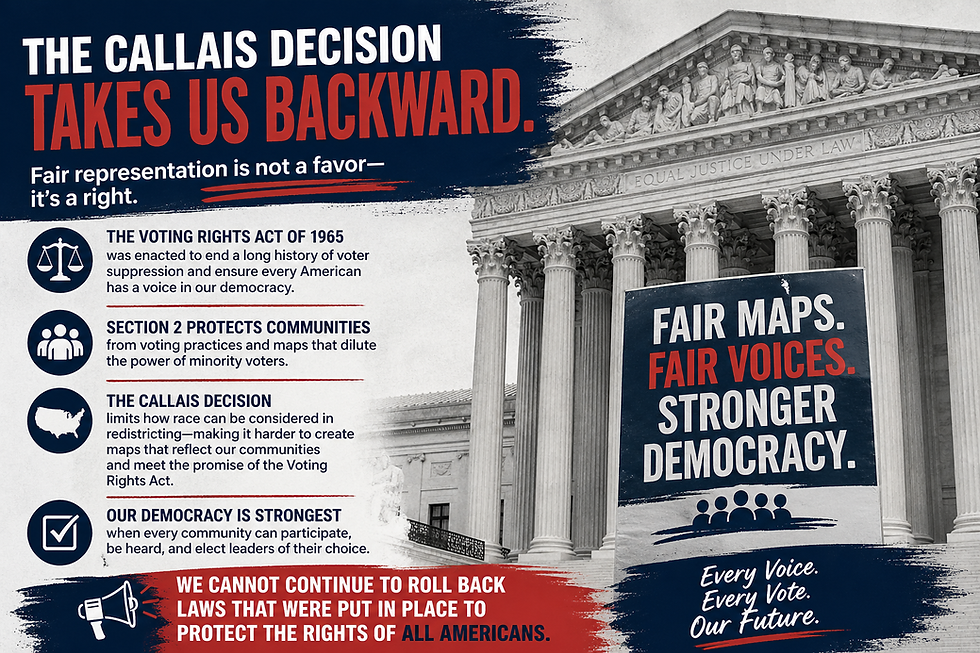
That’s why the Voting Rights Act included strong enforcement tools like Section 2, which ensures that voting systems—including district maps—do not dilute the power of minority voters. It recognized a simple but critical truth: fairness in democracy is not automatic; it must be protected, reinforced, and—when necessary—defended.
The Callais decision weakens that protection. By limiting how race can be considered in the redistricting process—even when it is necessary to comply with the Voting Rights Act—the Court has created new barriers for states attempting to draw fair and representative maps. In states like Louisiana, where Black residents make up a significant portion of the population, this decision makes it more difficult to ensure that representation reflects reality on the ground.
The implications extend beyond a single case or a single state. Decisions like this shape how laws are interpreted and enforced nationwide. They influence whether communities that have historically been excluded from full participation can continue to make progress, or whether that progress is stalled or reversed. At a time when trust in institutions is already strained, rulings that narrow protections risk deepening that divide.
We cannot continue to roll back laws that were put in place to protect the rights of all Americans. These protections were not created in a vacuum—they were hard-fought, hard-won responses to real injustices that shaped the lives of millions. Weakening them sends the wrong message about our commitment to fairness, equality, and representative government.
We should be working to expand access, strengthen participation, and ensure that every voice is heard—not limit the tools that help make that possible. The Voting Rights Act was built to move this country closer to its ideals. Decisions like Callais risk taking us backward at a time when we should be moving forward.
The responsibility now falls to leaders at every level—lawmakers, advocates, and community voices alike—to continue pushing for policies that uphold fairness and protect representation. Our democracy depends on it, and so does the public’s trust in the institutions meant to serve them.

Comments